


 Hi, my name is Gwendoline Ford.
As a hypnotherapist, Life Coach, Educator and Inspirationalist With more than 16,000 course students since 1994, I like to feel that I’m leaving a strong legacy in this industry.
“inspiring others to maximise their full potential”
Hi, my name is Gwendoline Ford.
As a hypnotherapist, Life Coach, Educator and Inspirationalist With more than 16,000 course students since 1994, I like to feel that I’m leaving a strong legacy in this industry.
“inspiring others to maximise their full potential” Apology Unaccepted: Would you forgive this person?
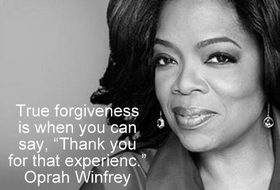

As a professional in the holistic therapy industry for many years I consider myself to be well versed in the spiritual laws surrounding atonement and forgiveness.
Atoning for a wrong committed against another – usually as a heartfelt apology – and forgiving others for the wrong committed against us – with or without the heartfelt apology – is emphasised as necessary in our spiritual evolution by most of the world’s great religions.
I have, for the most part, taken those spiritual laws for granted. I have assumed that all acts are forgivable, that an apology will rectify all wrongs and that forgiveness is a natural reaction to an apology…
But what happens when an apology is unacceptable? What happens when the act of forgiveness cannot be bestowed on another?
Does an apology always deserve to be accepted?
I ask these questions because of a discussion that took place between me and a dear friend recently. This discussion was about a wrong that my friend believed with a passion another had committed against him – without going into details, this wrong was quite significant and very malicious, and my friend still harboured strong negative feelings towards this other person. I asked my friend “what if she offered you a genuine apology for the hurt she caused you, would you forgive her then?”
Thinking this philosophical concept would instil a spiritual lesson in my friend I was quite taken aback when he responded with an emphatic “NO!”
I was so surprised by my friend’s response that I shared it with family, friends and fellow colleagues, little did I know that I would be more surprised by the response I received from them! Many of the people I shared this story with I would readily describe as “spiritually aware” so you can understand why I was surprised when most of them said they shared the same views.
After discussing their many stories and perceptions it became clear to me that, in some instances, an apology would simply never rectify the wrong that was committed, and forgiving another was simply too difficult to do.
Now, we aren’t talking necessarily about traumatic acts like murder, rape, torture or abuse – though there are individuals who have survived such horrendous acts and extended their forgiveness to the perpetrators – but other actions that, for the most part we can all relate to, such as being treated unfairly, being wrongly accused of something, having a loved one cheat on us, being lied to, having your work copied and presented as someone else’s, being robbed of something sentimental etc. Would an apology mean anything to us in these situations? Would it then naturally equate to forgiveness?
Most spiritual practises emphasise the importance of forgiving others for the wrongs they have done us – if not for their sake, but for ours. There is some research which suggests that those who do forgive live healthier and happier lives, after all it cannot be healthy holding onto strong negative feelings towards another. Holding onto resentments can make us physically and emotionally ill, even to the extent where we develop certain cancers – which many spiritual healers suggest is the long-term result of not forgiving.
The difference between acceptance and forgiveness
We may, for the most part, feel that we have forgiven another – convincing ourselves that this is the right thing to do and for all the right reasons – only to experience an event or person which triggers all of the pain and hurt we thought we had resolved by forgiving. This shows us that, instead of forgiving, we have only accepted what has happened and that, despite the compassion we have shown the other party involved, we are still unwilling to let go.
 Perhaps an apology will help us to forgive? Knowing, or believing, that the other person involved is sorry for what has happened may help us to not only accept what has occurred, but be willing to let go of all the pain and hurt by forgiving them. For some, apologising is difficult, but for others it is relatively easy; they are willing to take responsibility for their role in causing another pain or harm, and in a timely fashion convey their apology sincerely.
But does this mean that we must forgive when we are apologised to?
“We all too often think that just because someone apologises we have to forgive them,” a colleague of mine told me when we were discussing apology and forgiveness. “I get so angry when someone has done something awful to me and they just assume that by saying sorry it will make it all better. Well it doesn’t! And when I don’t accept their apology I am made to look like the bad guy!”
We live in a society which often looks poorly on those who refuse to accept an apology. We, whether consciously or unconsciously, view these people as proud or spiteful – they are the ‘bad’ person, and the individual apologising is in the right. But is this the reality? Even if an individual were sorry, is the mere act of uttering the words “I’m sorry” able to truly rectify the wrong which has been committed?
Take the following as an example of this…
Imagine that you have been accused of abusing your children by a neighbour who has a vendetta against you for something trivial. You experience child protective services taking your children away from you whilst they investigate these allegations; your friends, family and work colleagues are all asked whether they have witnessed any inappropriate behaviour from you towards your children which leaves you humiliated and angry. Then you discover that this story has been picked up by the local media and (though your identity is not disclosed) they make mention of where you live, the school your children go to, your occupation etc which compounds your feelings of humiliation and anger… You eventually lose your job, your partner leaves you due to the stress, and your family is divided between those who think you’re guilty and those who don’t…
Just when you think you can’t take anymore the investigation against you is suddenly dropped and it comes to light that it was your neighbour who had made the false allegation about you. Your neighbour then decides to apologise to you, saying “I’m sorry” in a heartfelt way. Would that be enough to forgive? Would that be enough to remedy all that has happened not only to you, but to your family and your children?
Unfortunately stories like this are not rare; there will always be a small minority of people we share this world with who live to cause trouble for others and do not take into account their actions until something disastrous happens. I am sure you all have such stories, where you have experienced – or committed – a wrong against another and felt that an apology was not acceptable. Or perhaps it was…
Perhaps, when it comes to the final act of forgiving, we need to acknowledge that it is something which cannot be willed but rather must take its own time to occur.
We have all heard the expression “time heals” and we may find that over the years (or many lifetimes!) we can learn to forgive.
Remember, self-forgiveness is part of forgiveness; forgiving ourselves for our role in causing others pain or harm is just as important and forgiving others.
Your Say…
Below I have listed a few things that have happened to staff in our office and to people around us.
Would you forgive in this scenario?
[poll id=”2″]
[poll id=”3″]
[poll id=”5″]
[poll id=”6″]
[poll id=”7″]
[poll id=”8″]
[poll id=”9″]
[poll id=”10″]
Final Word
I would love to hear your own stories about this topic and what each of you chose to do and why – did you offer or accept an apology? Did you forgive, or choose not to forgive, another? What were your reasons for doing so?
Click here to share your story
It is through sharing our life experiences that we can learn valuable lessons, as well as gain insight into the true nature of atonement and forgiveness.